
Many parents in Puchong ask us the same thing: “Is my child doing well in maths?” School marks can help, but they don’t always tell the whole story. That is why we talk about Math Age.
What is Math Age?
Math Age describes where your child’s maths understanding is right now, rather than which school year they are in. Two children of the same age can sit at different Math Ages, and that is perfectly normal.
Think of it as a starting point, not a grade. It isn’t a pass or fail, and it isn’t a label. It simply tells us where to begin so that learning makes sense.
Why school year isn’t the whole picture
Maths builds step by step. A child might be confident with some ideas but a little unsure about others that came earlier. When a gap stays hidden, the next topic can feel harder than it should, and maths can start to feel like a worry instead of a puzzle.
At AcaMaths, we teach for understanding first. So before we plan anything, we want to see what already makes sense to your child.
What is a MAD assessment?
The Math Age Diagnostic, or MAD, is a friendly first visit to see where your child is. It is not a test.
We sit with your child to see what already makes sense to them. You can come to the centre in Puchong Jaya, or we can meet online. After the MAD, you receive a parent report, and then you decide whether the centre feels like a good fit for your family.
The MAD is the starting point, and it is also the trial, so you can see how we work before you decide.
What happens at a MAD assessment
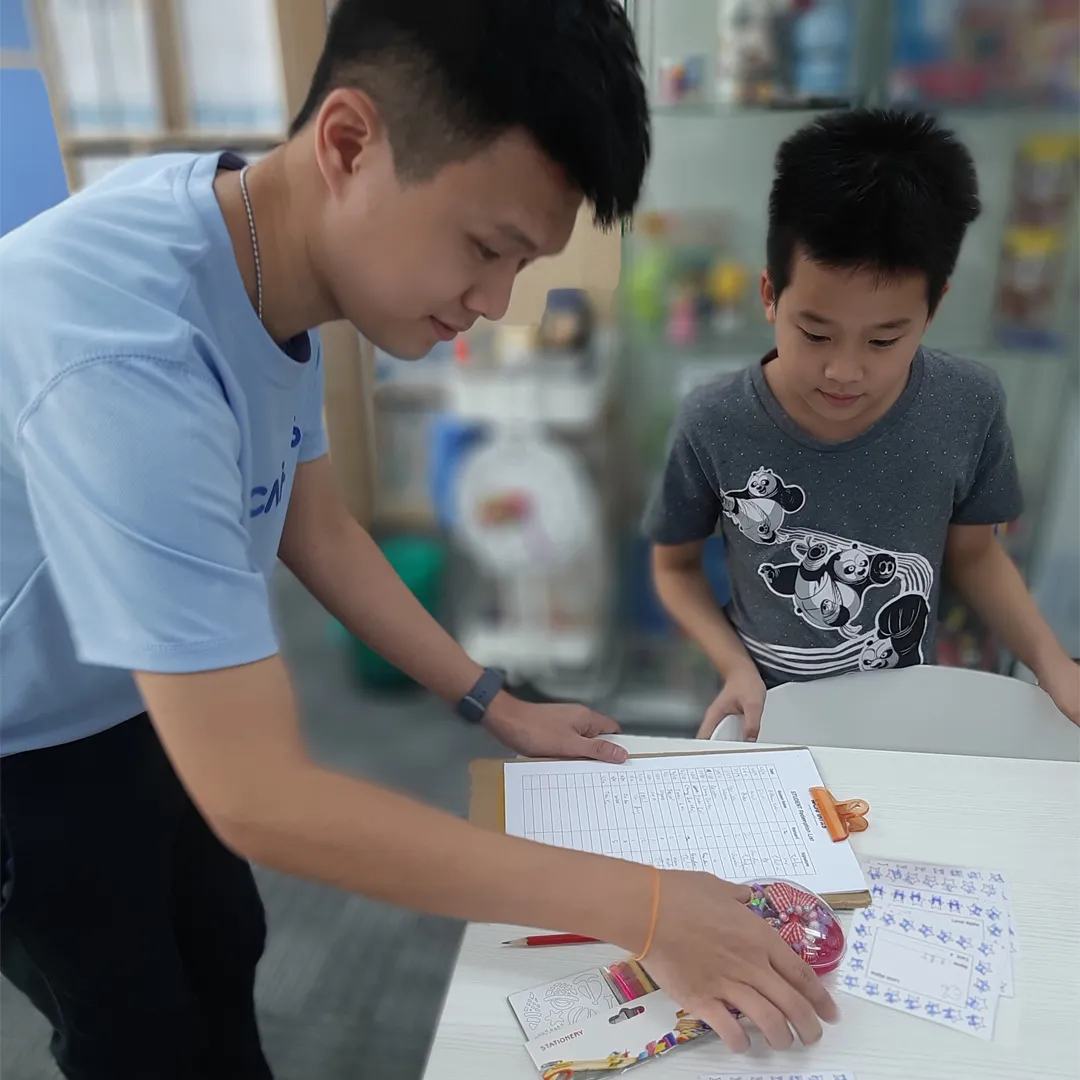
The MAD is a friendly first visit, not an exam. We sit with your child and see what already makes sense to them.
Afterwards, we use what we learn to place your child by Math Age. Your parent report shows where they are starting from, so you can see the picture too.
If you choose to meet online, we use Zoom. An online MAD needs a PC or laptop and a tablet with a stylus, both.
Starting where your child is ready
Once your child is placed, they follow an individual learning plan on our own curriculum. Our programmes are organised by Math Age, not only by school year:
- Junior Mathematics: Math Age 7 to 10
- Essentials Mathematics: Math Age 11 to 13
- Senior Mathematics I: Math Age above 14
- Senior Mathematics II: Math Age above 15
That means a child can begin exactly where they are ready, then grow in confidence from there. Lessons are in small groups, with one teacher to up to three students, so every child is seen.
A check-in that keeps going
A MAD isn’t a one-off. At each level there is a pre-assessment and a post-assessment, and parents receive a report at assessment time. When an enrolled child finishes their learning plan and is ready to move a step beyond, a MAD is done again.
For parents, this means clear updates on where your child started and what has changed, not guesswork.
Is a MAD right for my child?
We welcome children and teenagers from 7 to 17. A MAD can help if:
- your child says maths is “boring” or “too hard”, and you’d like to understand why
- your child seems capable, but doesn’t feel sure of themselves in maths
- you’re choosing a tutoring centre and would like to see how we work before deciding
You know your child best, and a MAD simply gives you a clearer picture to work with.
Book a MAD assessment on WhatsApp
Book a Math Age Diagnostic (MAD) assessment, with no upfront fee. The assessment fee only applies if you choose to enrol.
Send us a message and we will help you find a time that suits you and your child.